IT networks play an important role in all environments involving digital information – in critical infrastructure and operational technology (OT) environments, however, they directly support operationally critical or indispensable processes. This includes the production and processing of essential goods as well as key building automation, safety, and control systems for the respective facilities. System reliability – and therefore the reliability of the IT networks themselves – is the highest priority.
To achieve the required high availability, operational reliability, and resilience for critical infrastructure and OT networks, a clearly segmented architecture following defined principles is fundamental. We have visualized this in the LANCOM IT reference architecture for critical infrastructure and OT environments, which incorporates compliance requirements, legal regulations, and recommendations from the very beginning:
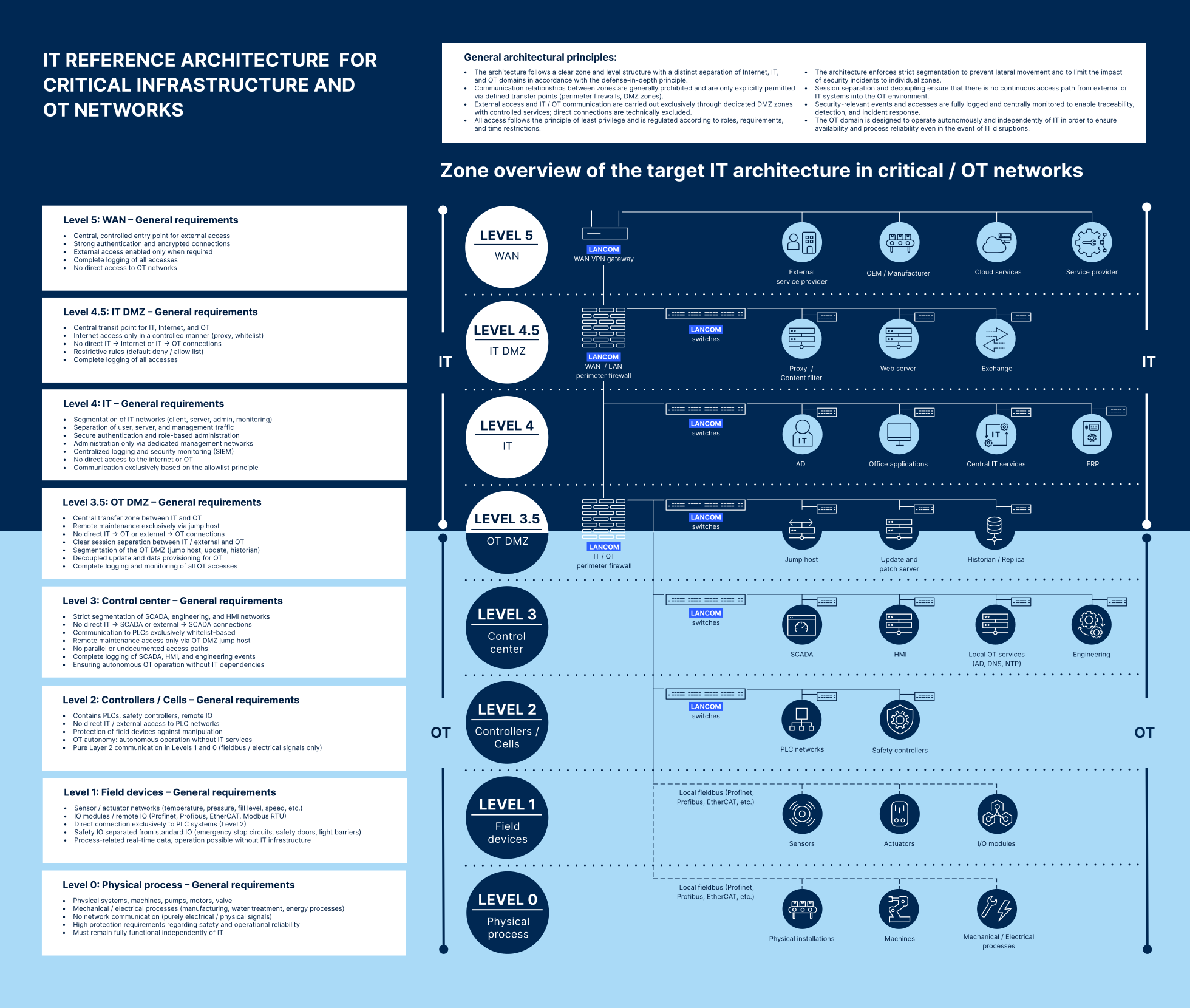
The LANCOM IT reference architecture for critical infrastructure and OT networks provides a secure foundation for operators, planners, and technical stakeholders during planning, operations, audits, change management, and incident scenarios, serving as a proven practical blueprint for successful IT network implementation.
Application areas of IT networks for critical infrastructure and OT
Our dedicated topic pages each describe typical use cases for critical infrastructure and OT environments. The individual application areas are: 1. Fundamental IT/OT architecture, 2. Modern IT networks for security systems, 3. Networking for building automation, 4. Secure Edge Computing, and 5. Control and signaling systems for transportation.

IT networks in OT and critical infrastructure
Anyone planning or modernizing critical infrastructure or OT environments primarily needs a resilient foundational model: clear separation between IT and OT, defined transition points, logging, and resilient operational processes. This topic page explains which architectural principles have proven effective and how the LANCOM IT reference architecture can be used as a technical framework. Learn more about the key design factors as well as secure remote maintenance, data decoupling, and update management for critical infrastructure and OT networks.

Security systems
Modern IT networks connect camera systems, access control, locking systems, as well as alarm and notification technologies. In critical infrastructure and OT environments, security systems require separated zones for the different security domains, encrypted and controlled communication paths, and modular scalability for autonomous and resilient operations. Together with our partners MOBOTIX and KENTIX, we provide holistic, standards-compliant solutions for the IT networking infrastructure behind security systems.

Building automation
Building automation becomes an IT architecture topic wherever HVAC (heating, ventilation, and cooling), energy systems, monitoring, and other building services must be operated securely, resiliently, and sustainably over the long term. This is implemented, among other things, through local control logic and edge computing, standardized interfaces and controlled rollouts, as well as hardened network devices and encrypted protocols. Our solution demonstrates how IT networks support modern building control within the context of a segmented and serviceable building management system.

Control and signaling systems for transportation
In transportation-related control and signaling systems, security, integrity, and availability must be implemented in a way that preserves safety requirements, deterministic behavior, and non-interference. Various encryption measures play a major role here, including the use of the RSCS SITLine Layer 2 network encryptor, as well as alignment with Safety Integrity Level (SIL) 3 and SIL 4 requirements and other mandatory standards. We show why transportation control systems require a particularly structured and secured IT architecture model.

Secure Edge Computing
Secure Edge Computing is one of the most important technologies in critical infrastructure and OT networks: it enables security-critical and time-critical processes to be processed and protected directly where the data is generated – at the edge of the network. Local firewalls provide network protection while also serving as a secure platform for isolated software applications. This allows sensitive data to be processed locally, reduces latency, and better protects critical infrastructures against cyberattacks and outages. Learn how the LANCOM Secure Edge Computing solution delivers higher speed, greater resilience, and stronger protection for confidential information.
Basic knowledge about IT networks in critical infrastructure and OT: Frequently asked questions and answers
What is OT security in critical infrastructure environments?
OT security in critical infrastructure environments protects networks and systems that control operationally critical or mission-critical processes. The primary focus is on availability, operational reliability, traceability, and controlled communication relationships.
Learn more about IT networks for critical infrastructure and OT
How can IT and OT be securely separated?
IT and OT are securely separated when productive OT environments cannot be accessed directly from the corporate IT network. Proven approaches include zone models with IT, IT DMZ, OT DMZ, and productive OT, as well as clearly defined control points for access, data flows, and changes.
Do critical infrastructure networks require a dedicated network architecture?
Yes, because historically evolved direct connections, uncontrolled data flows, and open service paths in OT environments represent operational and security risks. A dedicated IT architecture creates the foundation for clear zones, defined transition points, and resilient operational processes.
Learn more about the reference architecture for critical infrastructure and OT
How does OT security differ from traditional IT security?
OT security must protect the stable and safe operation of industrial systems and technical processes. For this reason, changes are more strictly controlled, remote access is more tightly restricted, and local operational capability is more important than in traditional office IT environments.
Why is a VPN alone not sufficient for remote maintenance in critical infrastructure environments?
Because remote maintenance in OT is not just about establishing a connection — it must be a controlled process. This includes strong identity verification, defined entry points, jump hosts, maintenance windows, and complete logging instead of direct access to productive zones.
Learn more about secure remote maintenance in critical infrastructure and OT networks
What are the benefits of an IT reference architecture for critical infrastructure and OT networks?
An IT reference architecture structures critical infrastructure and OT networks using clear zones, defined transition points, and controlled operational processes, serving as a clear implementation framework. This makes security, traceability, operational reliability, and recovery in complex environments easier to plan and manage.
Learn more about the IT reference architecture for critical infrastructure and OT