Critical infrastructure and operational technology (OT) environments are among the most sensitive structures in our society. Disruptions or even outages in essential healthcare, utility, education, or production facilities often have dangerous or even life-threatening consequences. For this reason, the critical infrastructure and OT sector requires an IT architecture model that continuously ensures availability, operational reliability, and traceability. Protection and operations must be considered together: with clearly defined zones, structured communication paths, controlled interfaces, and an operating model that remains sustainable even under disruptive conditions.
Due to these special protection requirements, the NIS-2 (EU 2022/2555) and CER directives (Critical Entities Resilience, EU 2022/2557) aim to increase the resilience of European critical infrastructures through standardized minimum requirements. These include, among other things, new registration obligations, stricter risk analyses and protective measures, as well as mandatory reporting of security incidents for operators of critical infrastructure facilities.
From a technical perspective, these requirements can be implemented with a suitable IT reference architecture for critical infrastructure and OT networks, which we will introduce below.
Critical infrastructure and OT networks require a reliable IT architecture model
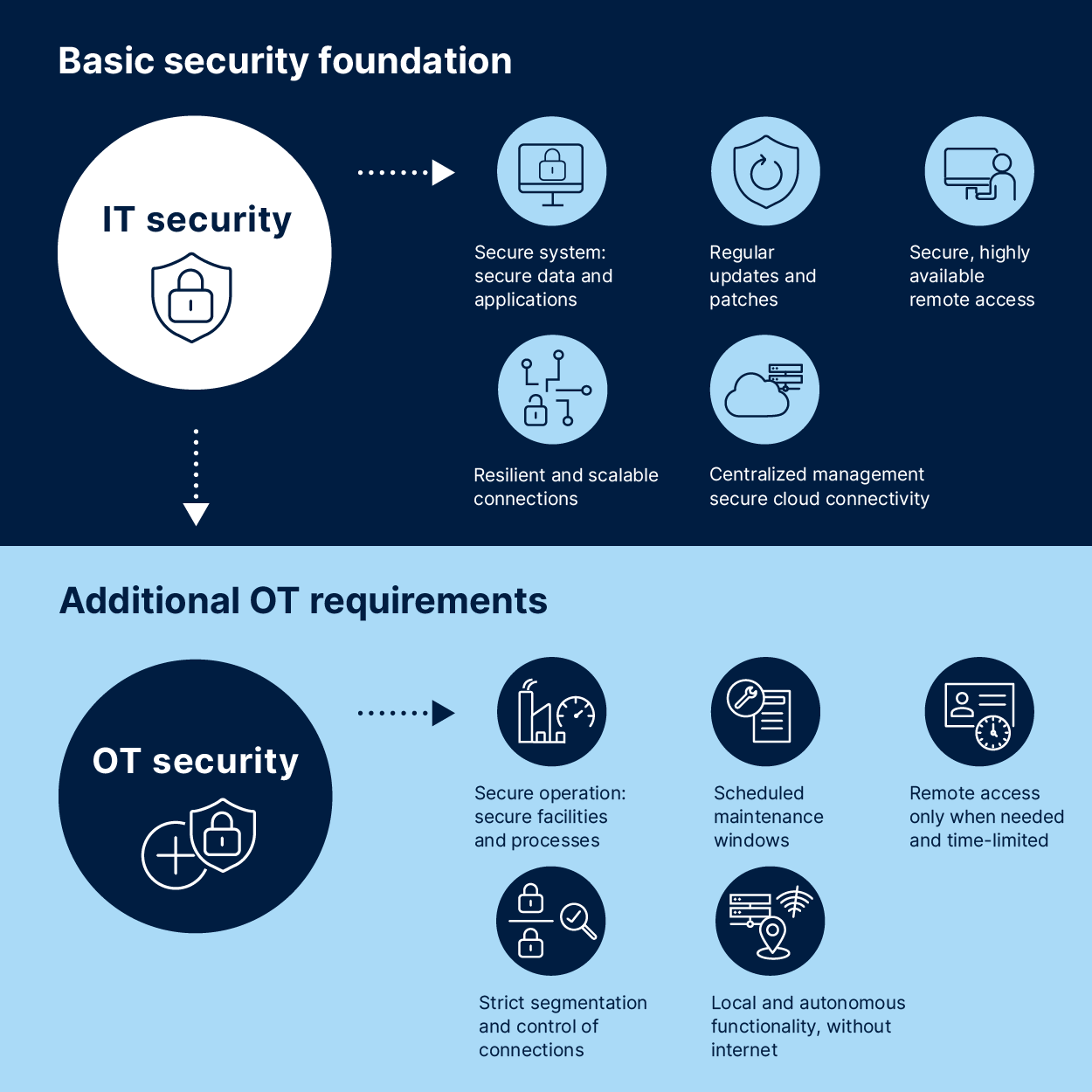
Critical infrastructure and OT environments are built on the same security foundation as traditional IT: systems, applications, connections, and access points must be protected.
For OT security, however, this alone is not enough. The focus here is not on flexible IT services, but on the secure and stable operation of facilities, processes, and technical infrastructures. That is precisely why OT security requires a reliable IT architecture model.
General IT security plus additional OT security
Traditional IT security primarily focuses on secure systems, regular updates, highly available remote access, resilient connections, centralized management, and cloud connectivity. In OT environments, however, additional requirements apply.
These include: planned operations within maintenance windows, remote access only when required and for a limited time, strict segmentation and control of connections, as well as local and autonomous functionality even without internet connectivity.
In critical infrastructure-related environments, this results in a clear target model: minimal and technically justified communication, controlled interfaces, and operations that remain manageable even under disruptive conditions.
What characterizes resilient critical infrastructure and OT networks?
Anyone planning or modernizing networks for critical infrastructure and OT must consider the following aspects:
Zone and conduit concept (segmentation according to IEC 62443 / BSI)
Critical infrastructure and OT networks must be consistently structured into security zones and conduits. A strict separation between IT and OT must be implemented. Communication between zones may only take place through defined and hardened communication paths (e.g., gateways, firewalls) and must be secured according to the principle of least privilege and role-based access control. Undocumented or historically evolved direct connections are not permitted.
Minimized, protected, and auditable communication
Communication relationships must be limited to the operationally necessary scope and explicitly approved (“default deny”). Data transmissions must be protected with regard to confidentiality, integrity, and authenticity (e.g., through encryption and secure protocols). All access activities, data flows, and security-relevant events must be logged in an audit-proof manner in accordance with BSI requirements, centrally analyzed, and continuously monitored.
Secure and robust operations, even during changes, maintenance, and data requests
Operational processes such as remote maintenance, configuration changes, and data provisioning must be secured through appropriate security measures (e.g., access controls, approval workflows, and session monitoring) and must not interfere with continuous plant operations. Critical OT functions must be designed to remain operational even in the event of disruptions to external networks (IT / WAN), ensuring resilience and partial autonomy.
The goal is to ensure operations remain as uninterrupted as possible while meeting the legally required protection standards.
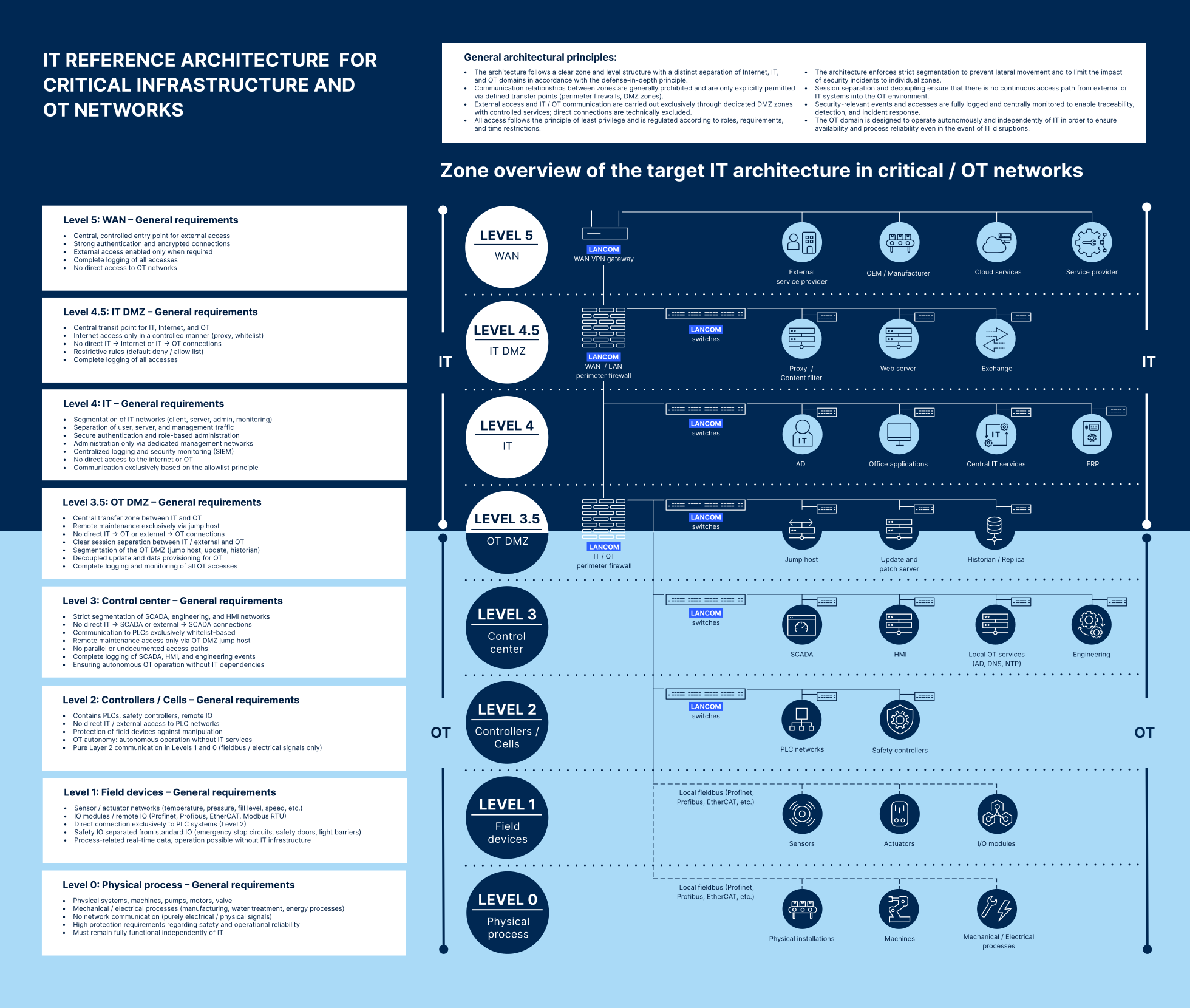
LANCOM IT reference architecture as a blueprint for critical infrastructure and OT networks
The LANCOM IT reference architecture for critical infrastructure and OT networks visually illustrates how a critical infrastructure network should be divided into zones, how transfer points and communication paths should be designed, and what should be considered when building the IT and OT network.
Feel free to click on the image to view the enlarged PDF version and download it if required.
Secure critical operational pathways in critical infrastructure and OT networks appropriately
In practice, OT security repeatedly comes down to three recurring operational pathways: access, data flows, and changes. These three pathways should therefore be considered from the outset as recurring operational realities and integrated into the overall design.
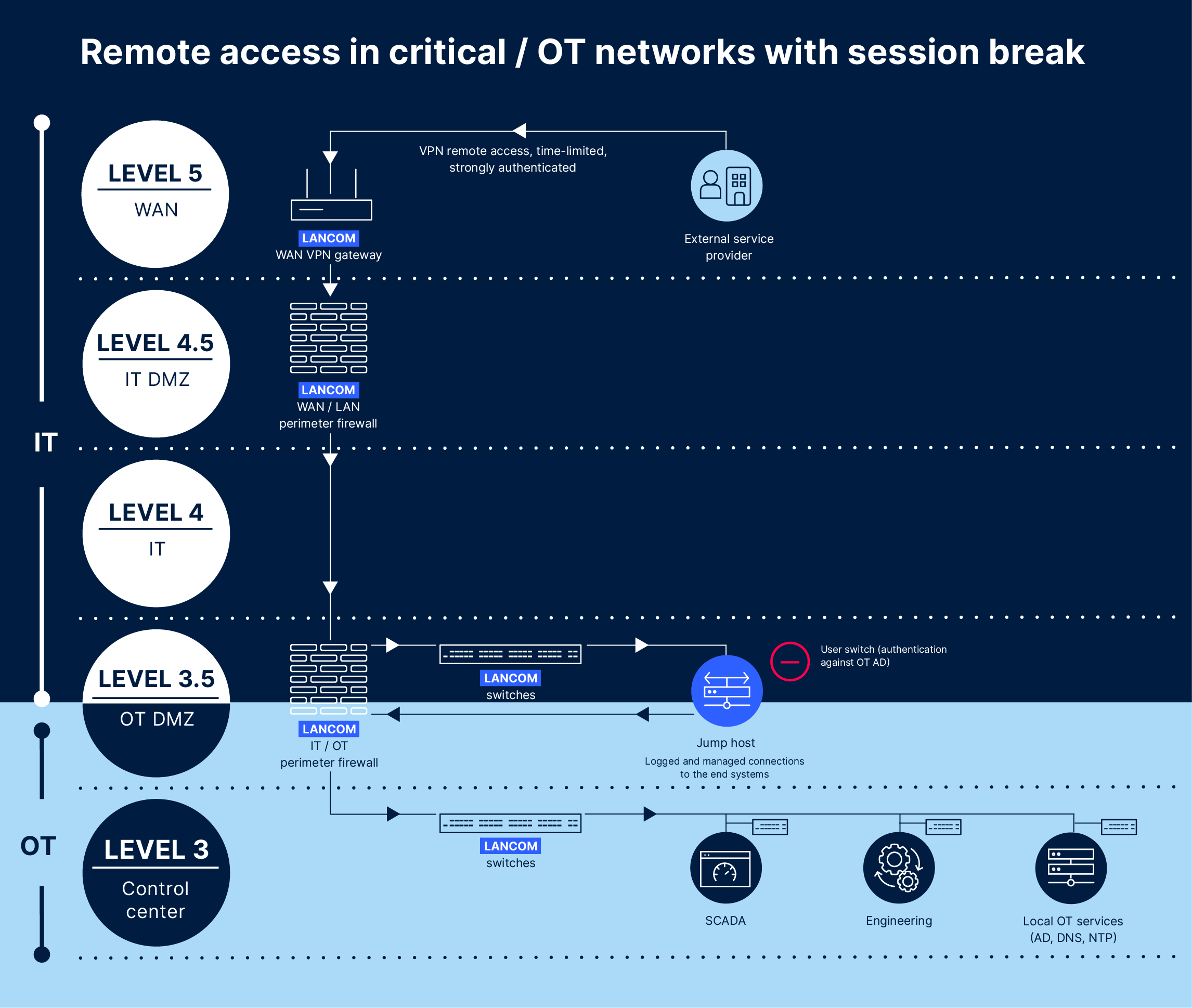
Remote maintenance without loss of control
A VPN alone is not a sufficient protection concept in critical infrastructure environments. Remote maintenance must be designed as a controlled process, including the following measures:
- strong identity verification,
- termination in a dedicated remote / DMZ segment (demilitarized zone, transition zone),
- session break via a jump host,
- time restrictions within defined maintenance windows, and
- comprehensive logging.
External or privileged access should never lead directly into productive OT zones.
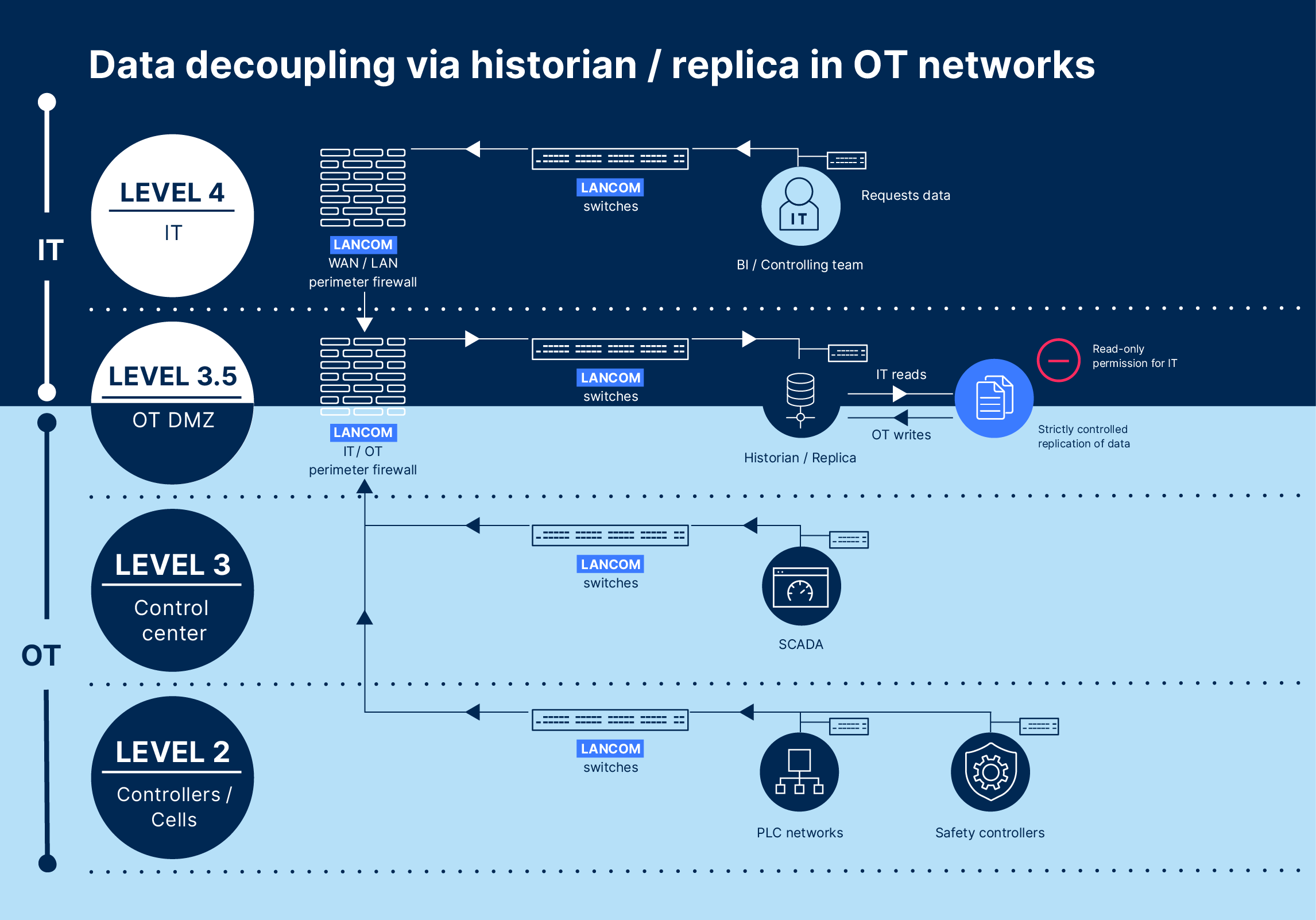
Providing data without exposing productive OT environments
Reporting, analytics, and compliance requirements demand data from critical infrastructure OT environments – but not every IT application requires direct access to productive OT systems for this purpose.
The recommended approach is secure data decoupling:
The OT environment writes the required data in a controlled manner to a historian/replica instance within or close to the OT DMZ, while IT systems access this data with read-only permissions.
This keeps productive OT databases and SCADA systems isolated from IT queries.
Organizing changes and updates in a controlled manner
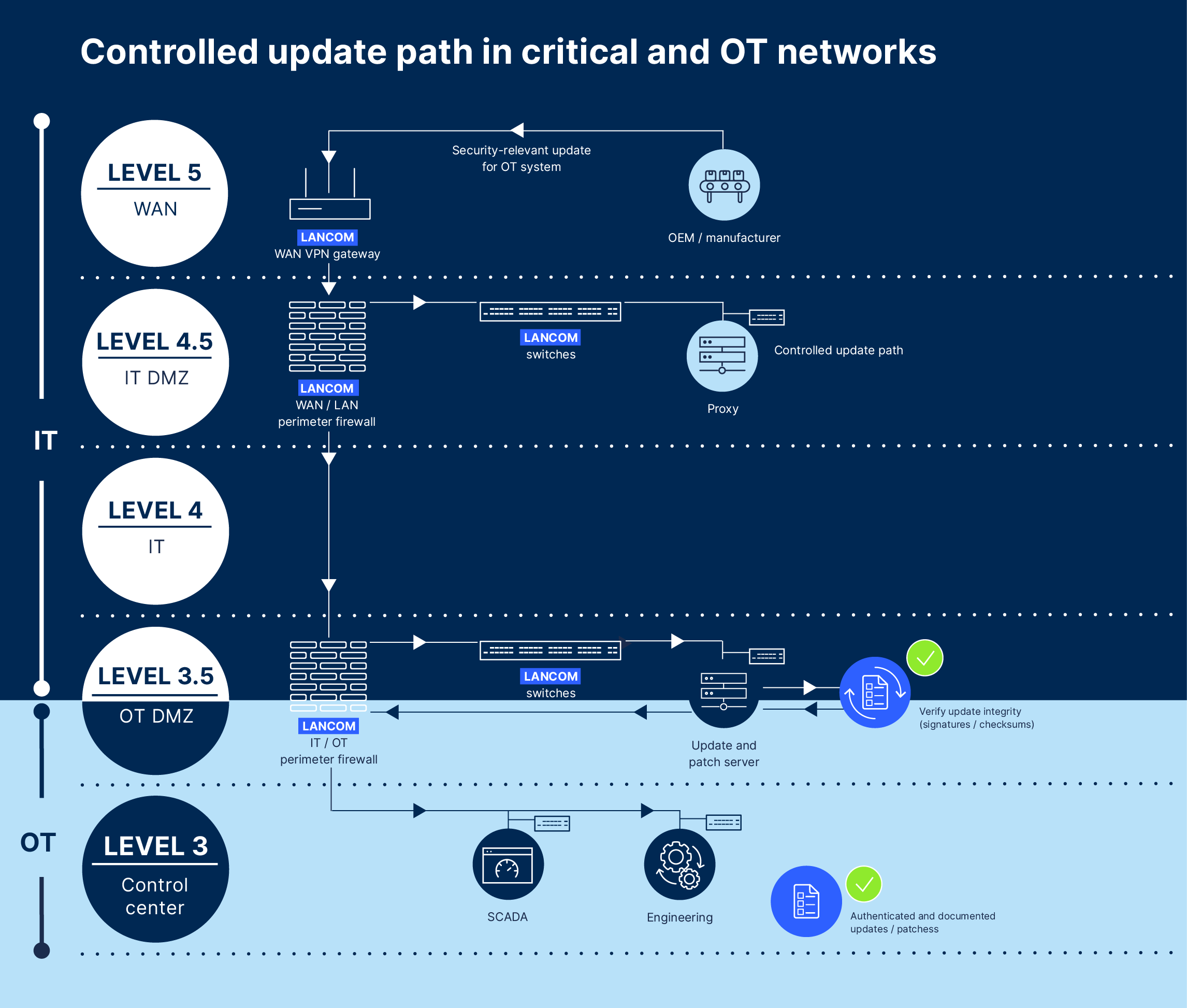
Especially in OT-related environments, changes are not handled as spontaneous standard IT processes.
Updates and patches are delivered through defined DMZ pathways using a repository / patch server, their integrity and authenticity are verified, approvals are documented, and rollouts are tied to scheduled maintenance windows.
The OT environment does not obtain updates directly from the internet. This is precisely what makes changes auditable and reduces supply chain risks during operations.
From reference architecture to project reality: How LANCOM supports critical infrastructure and OT environments
LANCOM Systems stands for digital sovereignty, supply chain transparency, and compliance (e.g., NIS-2 and CER directives), supported by a high level of manufacturing depth in Europe.
With our IT reference architecture, we support the compliant implementation of resilient and secure IT infrastructures for critical infrastructure and OT environments. In addition, our products and networking solutions provide the required level of cybersecurity, operational continuity, and data sovereignty for critical infrastructures:
For example, LANCOM R&S®Unified Firewalls secure segment boundaries as WAN / LAN perimeter firewalls and IT / OT perimeter firewalls, enforce default deny policies and explicit approvals, and make transitions between IT, the IT demilitarized zone (IT DMZ), the OT demilitarized zone (OT DMZ), and productive OT environments controllable.

In the OT DMZ, these network components are complemented by a jump host, update / patch server, and historian / replica systems to create a practical overall model that enables controlled remote maintenance, data provisioning, and change management without unnecessarily exposing the productive OT environment.
LANCOM Systems provides a robust, auditable, and sovereign networking foundation that enables organizations to implement critical infrastructure and OT requirements in a structured, compliant, and sustainably operable manner.

Security technology
Building an autonomous IT network for implementing security technology enables the secure and independent operation of critical security functions – isolated from productive corporate or public networks.
For example, cameras, monitoring and alarm systems, as well as electronic locking and access control systems, are consolidated within a dedicated, isolated network and centrally managed.

Building automation
Modern buildings are evolving into highly interconnected digital systems.
An autonomous building management system (BMS) centralizes the control of energy, climate, lighting, access, and security while ensuring that operational building technology (OT) can be operated in a resilient, secure, and economically sustainable manner over the long term.
Secure automation is therefore a key efficiency factor.

Traffic control systems
Where integrity, non-interference, and resilient operations are as critical as they are in traffic control and signaling systems, both IT and OT must meet particularly demanding requirements.
In these environments, the target IT/OT network architecture requires clearly separated communication relationships, dedicated secured management zones, controlled transition points, and integrated security measures — without impermissibly affecting safety or operational behavior.
IT networks for critical infrastructure and OT with LANCOM
LANCOM Systems provides a networking infrastructure that supports the requirements of critical infrastructure and OT security in accordance with regulatory guidelines, such as the German the BSI IT Baseline Protection framework and IEC 62443.
The solutions enable the consistent implementation of segmentation and zone concepts, including secure transition points and centrally managed communication relationships based on the principles of least privilege and default deny.
By using standards-based technologies, integrated VPN mechanisms, and centralized management, protected, traceable, and audit-proof communication is ensured. Functions for logging, monitoring, and integration with higher-level security systems (e.g., NAC, SIEM) can be connected through the LANCOM IT Security Ecosystem. With a LANCOM critical infrastructure / OT network solution, you benefit from long-term availability, stable software maintenance, and reliable operations even in distributed infrastructures.
Feel free to contact us directly via the contact form – we will be happy to advise you individually and without obligation regarding your project.
We look forward to working together with you to strengthen digital sovereignty and resilience in Europe.